




The short version: A sell-side quality of earnings (QofE) is an independent analysis of a company’s real, recurring earnings, commissioned by the seller before going to market. When the sellers of Florida Recycling Services skipped it, the buyer’s own post-close review found overstated revenue and understated costs, and the sellers gave back an estimated $25-40 million rather than litigate. An independent, seller-side earnings analysis — at a fraction of that cost! — would have let them correct the timing issues, restructure the related-party arrangements, and negotiate the consideration mix from a position on knowledge.
I think about the owners of Florida Recycling every time a banker tells me their seller-client doesn’t want to spend $50,000 on a sell-side quality of earnings.
They had built something real. After three decades of work, they had a Florida recycling business with a 2,000-ton-per-day facility under construction in Orlando, route density across the state, and enough operating cash flow to attract a publicly traded buyer with a serious roll-up thesis.
In November 2003, Capital Environmental Resource Inc. announced it was acquiring Florida Recycling Services for approximately $128 million in cash and 3.25 million shares of stock. By the time the deal closed five months later, the terms had shifted. Cash consideration came down to $98.5 million. Share consideration nearly tripled to 9.25 million. The sellers closed in April 2004 and took the rest of the spring off.
Five months later, they were back at a conference table in Florida. Across from them sat consultants the buyer had engaged to investigate why the acquired business was underperforming.
The consultants had findings. Revenue overstated by $2-3M. Hauling and disposal costs understated by another million. A property distribution to shareholders that had run three and a half million dollars through the operating P&L.
The original auditor’s unqualified opinion, signed in February 2004 by a respected Chicago firm, could no longer be relied upon. The buyer wanted the family to pay it back.
The sellers disagreed with the findings. They said so, in writing, in the SEC filing that documented what came next. Despite this, they paid $7.5 million in cash and returned 500,000 shares of stock. They handed over the title to the 2,000-ton-per-day Icehouse recycling facility for nominal consideration, after agreeing to fund its construction themselves. The settlement resolved the matter without adjudication of the underlying disagreement.
By a conservative estimate, they gave back somewhere between $25 and $40 million of what they had just been paid.
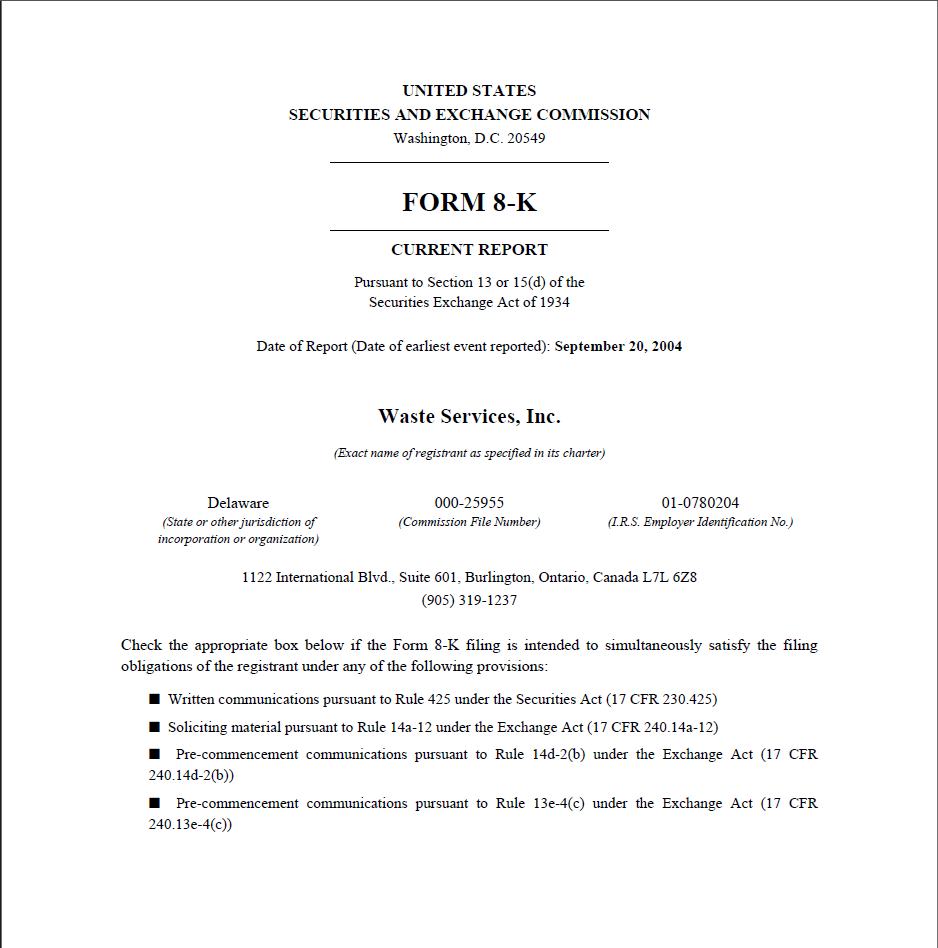
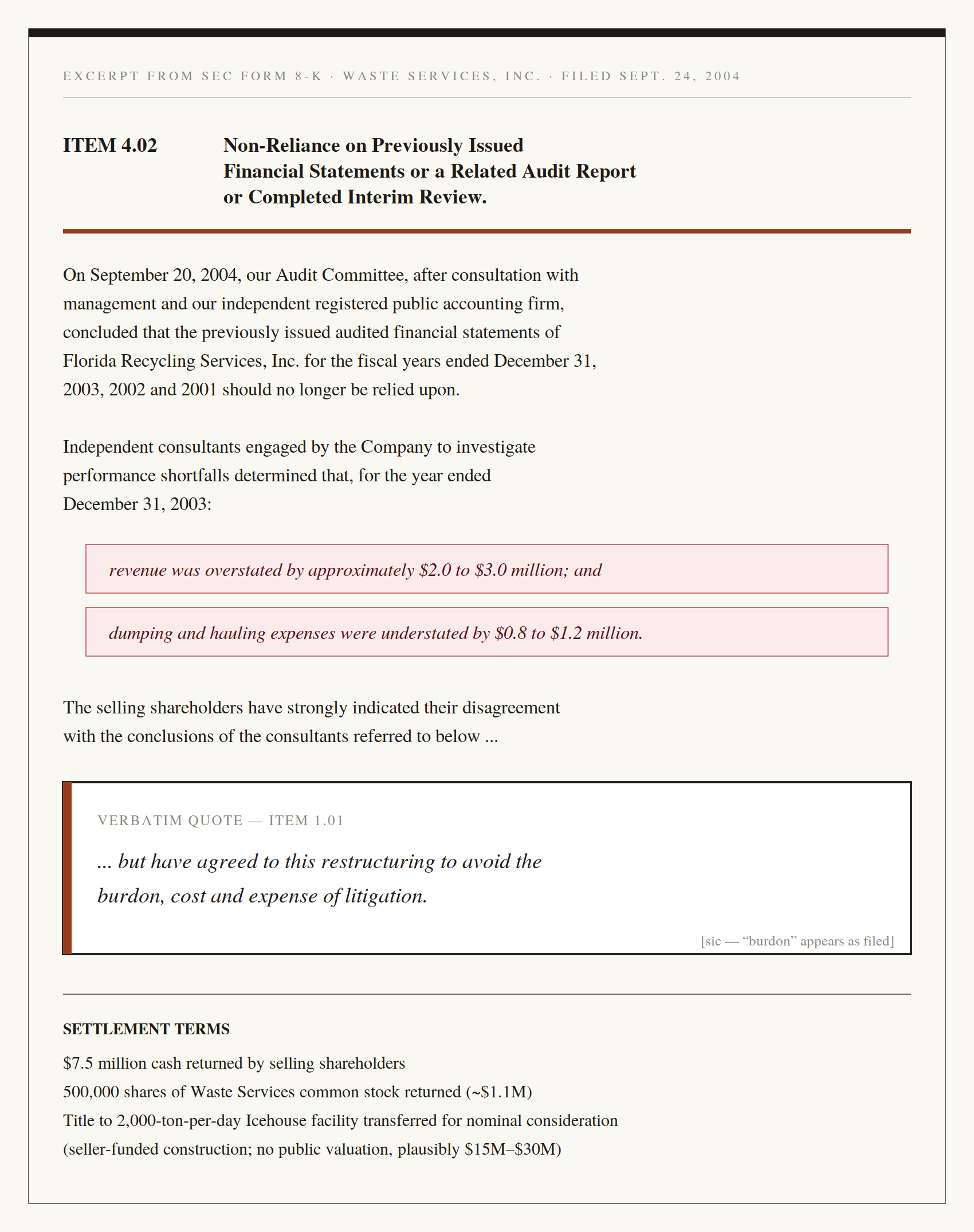
The 8-K filed September 24, 2004 explains why in 13 words:
“agreed to this restructuring to avoid the burdon [sic], cost and expense of litigation.”
That is what loss of leverage looks like in writing.
What Skipping a Sell-Side Quality of Earnings Actually Costs
The settlement, executed on September 24, 2004, had three components.
- The selling shareholders paid $7.5 million in cash back to Waste Services.
- They returned 500,000 shares of common stock, which the 8-K/A later valued at approximately $1.1 million based on the September 24 market price of about $2.20 per share.
- And they agreed to fund construction of the 2,000-ton-per-day Icehouse recycling and transfer facility in Orlando, then hand it over to Waste Services for nominal consideration.
The Icehouse piece is the one that really hurts. The 8-K does not put a dollar value on the facility. But a 2,000 TPD recycling and transfer facility in Orlando, in 2004 dollars, is plausibly a $15 to $30 million asset by construction cost alone, and considerably more by route-density and volume economics. The sellers agreed to fund the construction and then hand over title. That is a cash outflow, an asset given up, and an opportunity cost all in one line of the settlement agreement.
Realistic total value returned by the selling shareholders: somewhere between $25 and $40 million against original consideration of $149.8 million. That’s 15-25 percent of the deal, returned post-close, before the sellers even knew the full magnitude of the accounting issues.
The timing matters. The sellers settled on September 24, 2004. The BDO Seidman re-audit of Florida Recycling’s 2001, 2002, and 2003 financials was not filed with the SEC until July 8, 2005, nine and a half months later.
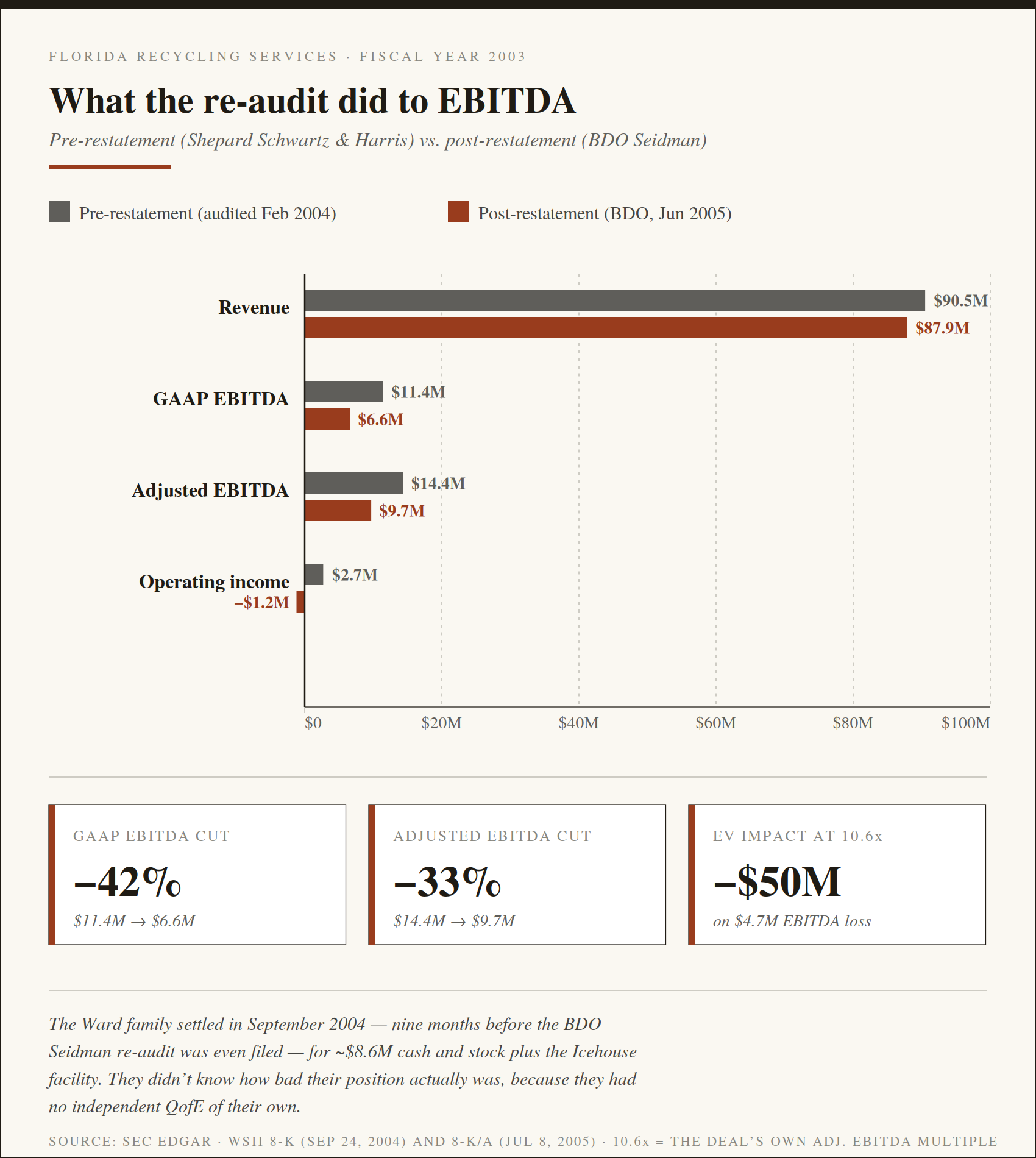
Their give-up was sized to the preliminary consultant findings the buyer had disclosed in the 8-K. The full re-audit, when it came, was worse:
- 2003 GAAP EBITDA was cut from approximately $11.4 million to $6.6 million, a 42% reduction.
- Adjusted EBITDA fell from roughly $14.4 million to $9.7 million, a 33% reduction.
At the deal’s own 10.4x adjusted EBITDA multiple, that is roughly $49 million of theoretical enterprise value erosion on a $4.7 million EBITDA reduction.
The selling shareholders captured roughly half of that gap through negotiation. With a sell-side Q0fE in 2003, they don’t close at $149.8M. They close lower, or later, with clean numbers.
Why a Sophisticated Buyer Still Overpaid for a Waste Company
For anyone who does M&A in the waste and recycling sector, the strategic logic of the Florida Recycling acquisition deserves a paragraph of respect. Capital Environmental was executing a serious Florida roll-up thesis: combining Florida Recycling with the Northern and Central Florida operations it had purchased from Allied Waste, the company would control thirteen collection operations, four landfills, six transfer and processing facilities, and four recycling facilities, with a planned landfill at Omni to internalize the waste stream. The CEO, David Sutherland-Yoest, had come out of Waste Management and USA Waste. Lehman Brothers put up a $220 million senior secured credit facility. This was a sophisticated buyer doing a real thesis, not an opportunistic bottom-fisher.
The sellers had built something a buyer like that wanted. Recycling volume, hauling routes, and a major transfer facility under construction in the fastest-growing Florida MSAs. At the announced terms of $128 million in cash and 3.25 million shares of stock, and with Capital Environmental’s stock trading in the $6 range in late November 2003, the deal implied a total consideration of roughly $147 to $149 million.
By close in April 2004, the mix had moved substantially. Cash consideration was down to $98.5 million. Share consideration had tripled to 9.25 million shares, which the company booked at $5.54 per share — approximately $51.4 million of equity value. Total consideration was approximately $149.8 million against Florida Recycling’s reported 2003 adjusted EBITDA of roughly $14.4 million. The implied multiple worked out to about 10.4x adjusted EBITDA, defensible for a sector roll-up in that market.
For a banker reading this, the composition of that shift matters more than the aggregate. Total deal value moved up only two to three percent between announcement and close. But cash consideration fell by $29.5 million, and equity consideration rose by roughly $31 million. It was almost a one-for-one substitution.
The selling shareholders accepted equity risk in place of cash certainty. From a leveraged, acquisitive buyer executing a complex Florida roll-up with Kelso preferred stock, warrants, and $220 million of senior debt in the capital structure.
Between the April 30, 2004 close and the September 24, 2004 settlement, that equity lost sixty percent of its value. The stock went from the $5.54 issuance price to approximately $2.20.
The seller’s 9.25 million shares, worth $51.3 million at close? They were only worth $20.4 million five months later. Before the buyer’s consultants had extracted a single dollar of settlement, the equity portion of the sellers’ consideration had already lost more than $30 million of paper value.
This is the negotiating context the September 2004 conversation actually happened in. The sellers were sitting on rapidly declining stock in their acquirer, watching their consideration evaporate in real time, when the buyer’s consultants walked in with findings and asked for cash back and the title to the Icehouse facility.
Had the sellers been armed with a QofE and the negotiating leverage that brings, they could have protected both the form and finality of consideration. Instead, they were paid in a currency that could be taken back twice, once by the market and once by the settlement.
The sellers did not just lack their own earnings analysis. They lacked it in a moment when they were already massively exposed and financially bleeding on the retained equity. Fighting became structurally harder because they had less to fight with.
And that was before the accounting problems became the focus.
What the Buyer’s Consultants Found After the Deal Closed
On September 20, 2004, the Audit Committee of the Waste Services board concluded that the previously issued Florida Recycling financial statements for fiscal years 2001, 2002, and 2003 could not be relied upon. The consultants the buyer had engaged over the summer had come back with findings.
From the September 24, 2004 8-K:
“Sales are overstated by an estimated range of approximately $2.0 to $3.0 million and Dumping and hauling expense is understated by an estimated range of approximately $800,000 to $1.2 million.”
That was the summary. The underlying issues, some of which showed up later in the BDO Seidman re-audit filed in July 2005, were even more extensive:
- A $3.6 million gain on a property distribution to shareholders had been booked to the operating P&L rather than treated as a non-operating owner transaction.
- Related-party transactions, disclosed in Note H of the audited financials but never normalized, included $3.06 million of management fees, $852,000 of insurance, $1 million of capitalized container refurbishing paid to a related entity, and $980,000 of trucks and parts.
Any buyer’s quality of earnings review would have normalized these to arm’s-length equivalents.
And what about those overstated sales and understated expenses in the summary? The overstatement was primarily from timing and cut-off issues on route-based service revenue. The understatement came from accrual mismatches between the month waste was hauled and the month the disposal invoices arrived.
Here is what should stop every banker reading this: every one of these items was disclosed in the audit footnotes the sellers handed Capital Environmental at signing.
The original auditor had issued an unqualified opinion in February 2004. That opinion was technically correct. Audits confirm GAAP conformance, not earnings quality. Nobody on the seller side had pressure-tested any of the disclosed items before the buyer’s consultants did it for them, six months after close.
| Six Financial Red Flags Before You Sell a Waste or Recycling Business |
An Audit Is Not a Quality of Earnings: Three Lessons for Sellers
There are three takeaways here for anyone advising a lower-middle-market seller in this sector.
An audit is not a quality of earnings. Audits confirm GAAP conformance. A QofE review confirms that the earnings are real, recurring, and defensible at the multiple. Capital Environmental’s consultants were not doing an audit. They were doing something an audit is not designed to catch. When the sellers said their audited financials were reliable, they were technically right… but practically defenseless.
Without an independent third-party financial analysis of your own, you have nothing to negotiate from. The sellers disagreed with the consultants’ findings. They said so, in writing, in an SEC filing. It did not matter. Disagreement without analysis is just objection. And objection without leverage is just a delay before settlement. The sellers were not fighting the buyer’s numbers with better numbers of their own. They were fighting the buyer’s numbers with the same audited statements the buyer had already rejected.
The waste and recycling sector has predictable failure modes. Route revenue cut-off timing, hauling and disposal expense accruals, container deposits, fuel surcharge treatment, related-party arrangements, owner-driven capital allocation. Sophisticated buyers in this sector know exactly where to look. They budget for it in their diligence process. A seller without sector-specific analytical defense is walking into a fight where the other side already has a map.
The sellers lost this fight not because their business was bad. Florida Recycling had real routes, real customers, real volumes, and real cash flow. They lost this fight because they walked into it with someone else’s document – and no version of their own.
In the end, the sellers paid $7.5 million in cash, returned $1.1 million of stock, and handed over a 2,000-ton-per-day recycling facility for nominal consideration to learn that an audited financial statement is not the same as a defensible earnings story. Their counterparty knew the difference. The sellers found out five months too late.
Sources: This analysis is based entirely on public filings by Waste Services, Inc. (formerly Capital Environmental Resource Inc.) with the U.S. Securities and Exchange Commission, including the Form 8-K filed September 24, 2004, the Form 8-K/A filed July 8, 2005, and the Form 10-K for fiscal year 2004. All figures are drawn from those filings or reconstructed from disclosed line items. netgainCFO has no relationship with any party to the transaction.
Want to discuss a specific seller-client, or get a pre-market read on a set of financials? Click here for a free consultation.
***
Frequently Asked Questions
What is a sell-side quality of earnings report?
A sell-side quality of earnings (QofE) report is an independent financial analysis a seller commissions before going to market. It normalizes reported earnings, identifies non-recurring items and accounting issues, and produces a defensible EBITDA figure. Unlike an audit, which confirms GAAP compliance, a QofE confirms that earnings are real, recurring, and defensible at the deal multiple.
How much does a sell-side quality of earnings cost?
A conventional sell-side QofE typically costs between $40k and $150k, depending on revenue, number of entities, and complexity. Lower-cost, strategically scoped alternatives such as netgainCFO’s valueX-RAY are designed to deliver QofE-level insight with a CFO perspective on value creation.
What is the difference between an audit and a quality of earnings report?
An audit confirms that financial statements conform to GAAP. A quality of earnings report confirms that the earnings themselves are real, recurring, and defensible at the transaction multiple. Florida Recycling had a clean unqualified audit opinion; a buyer’s later review still found revenue overstated by $2-3M and costs understated by $0.8-1.2M.
What is a retrade in M&A?
A retrade is when a buyer lowers the price or changes terms after the letter of intent is signed, usually citing findings from due diligence. Without an independent sell-side quality of earnings to anchor their position, sellers have little basis to push back — as the Florida Recycling sellers discovered when they returned $7.5M in cash, 500,000 shares, and a recycling facility.
What financial issues most often reduce the sale price of a waste or recycling company?
The most common are revenue cut-off timing on route-based contracts, hauling and disposal expense accrual mismatches, unnormalized related-party transactions, shareholder distributions misclassified in the P&L, container deposits on the balance sheet, and owner-driven capital allocation. Each was present in the Florida Recycling financials and disclosed in the audit footnotes.
Can I use my audited financial statements instead of a quality of earnings report when selling my business?
No. Audited financials confirm GAAP compliance but do not normalize earnings or defend them at the deal multiple. Sophisticated buyers commission their own quality of earnings analysis regardless. Without your own sell-side analysis, the buyer’s version becomes the only analysis in the room.
***
How valueX-RAY Helps Waste and Recycling Sellers See What Buyers Will See
valueX-RAY is purpose-built for the solid waste, recycling, environmental services, and resource recovery sector, and it is designed for financials that are mostly clean but not perfect — the situation most sellers are actually in. It exists so that the next owner in this sector who sits across from a buyer’s consultants understands, and can defend, their own earnings before the buyer takes control of the story.
This is the reason netgainCFO built valueX-RAY. A conventional sell-side quality of earnings report is a powerful tool, but it comes with real barriers: conventional QofE reports cost upwards of $40,000 to $150,000 and often take three to six weeks or more to produce. For many owners, that cost and timing make a full QofE impractical until it is too late to act on what it finds.
valueX-RAY is designed to show sellers what buyers will see at a fraction of the time and cost of a traditional QofE. It is CFO-led: experienced CFO judgment makes the output credible and defensible. Finally the report contains a Value Creation Plan with clear recommendations to strengthen earnings before going to market.
Click here to learn more about valueX-RAY.
netgainCFO provides fractional CFO and controller support to owner-operated and PE-backed companies in the environmental services, recycling, and waste industries. Its valueX-RAY service helps sellers see what buyers will see — at a fraction of the time and cost of a traditional quality of earnings report — before they go to market.