





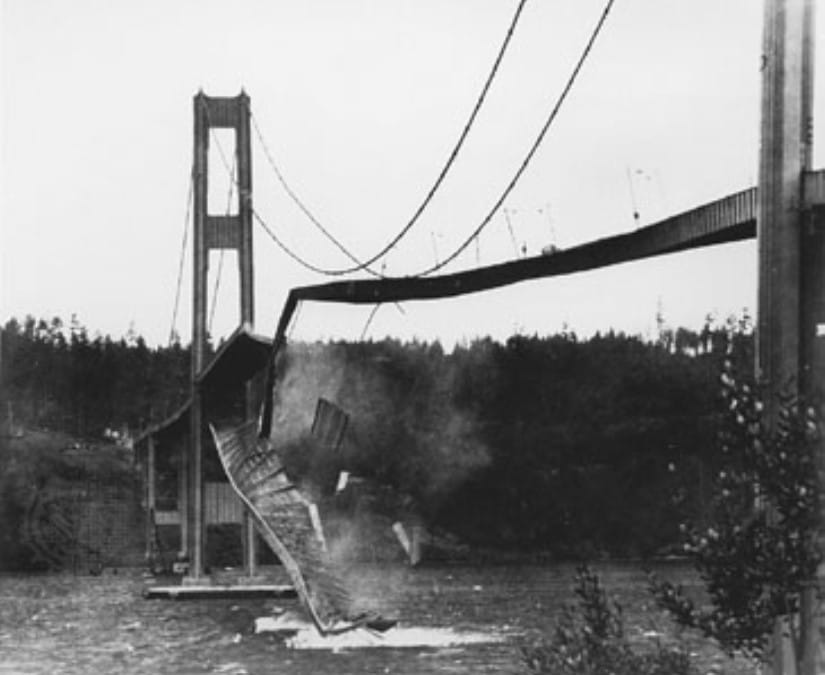
The Tacoma Narrows Bridge collapsed on November 7, 1940, just four months after opening. At the time, it was the third-largest suspension bridge in the world. The bridge began oscillating violently in 40 mph winds, twisting in widening waves, until the deck tore apart and fell into Puget Sound.
The collapse became one of the most studied structural failures in history and permanently changed suspension bridge design. Engineers overhauled their methods: standardizing wind tunnel testing, developing new analytical frameworks, and embedding those lessons so thoroughly that no major suspension bridge has failed from the same cause since. The discipline is known as “failure analysis” – the systematic study of breakdowns to prevent recurrence.
Engineers institutionalized the lessons. The question is whether business leaders do the same. In both engineering and business, collapse is rarely caused by a single dramatic error. It is the result of systemic weaknesses that surface under stress.
Learning from Business Failures
One of the most instructive failures I’ve witnessed involved a $300 million communications equipment distributor and managed services provider where I was brought in as interim CFO.
My first step was building a 13-week cash forecast. It revealed an imminent need for unplanned borrowings that would push the company to its covenant limits.
About a month later, we uncovered accounting irregularities from earlier in the year. The correction reduced EBITDA, which was already under pressure from declining revenue.
The restated EBITDA pushed the company into an outright covenant default. We moved immediately into restructuring mode, negotiated a forbearance agreement with lenders, and ultimately sold the business to save what we could. Both the private equity sponsor and the employees who had invested alongside them took a complete loss.
The failure had no single cause. The company had grown rapidly during the five years that the PE firm owned it, largely through acquisitions. But profit stayed flat because costs grew just as fast as revenue. Systems were layered without integration, steadily eroding operating efficiency.
External pressures compounded the situation. One of its largest OEM partners was rumored to be heading toward bankruptcy, prompting the company’s own customers to delay or cancel orders. Internally, the sales compensation plan incentivized the wrong behaviors – rewarding bookings volume rather than profitability or collections – and there were no reliable forward-looking KPIs to show leadership what was coming.
During the default period, lenders restricted access to credit facilities. Internally generated cash flow became the company’s only lifeline. I worked directly with the sales team to shift their focus to collecting aging receivables that had been neglected for years.
When we mapped the company’s systems by major business process (HR, accounting, billing, quoting) the picture was damning. HR had one system company-wide. But almost every other process had multiple systems that mapped almost perfectly to each acquisition. There was no true system of record. That made even basic things – such as producing a timely cus
tomer quote — painfully slow.
It reinforced a pattern I’ve observed repeatedly: failure is almost always systemic. There is an old saying that success has many fathers. In my experience, so does failure. And when cash disappears, your options disappear with it.
Common Patterns in the Middle Market
Companies rarely fail because of one dramatic mistake. Most financial breakdowns stem from a handful of operational weaknesses that quietly compound.
The biggest one is that companies outgrow the systems that got them there. Revenue, headcount, and complexity all increase, but the infrastructure for making good decisions doesn’t keep up. Founders continue approving routine decisions, cash management relies on the bank balance, and strategy becomes reactive rather than deliberate.
The second failure I see often is confusing growth with health. Revenue is going up, but margins are drifting, cash is getting tighter, and leadership can’t quite explain why. Growth amplifies inefficiencies; it doesn’t conceal them. By the time leadership sees it, the margin for error is gone.
The third is the tendency to defer hard decisions, whether on pricing, people, or unprofitable customers. Leaders often know what needs to be done, but they delay decisive changes because the business is still functioning. Over time, strategic options narrow. Eventually, cash, lenders, or circumstances make the decision for you – and it’s usually a worse outcome.
Underlying all of these issues is a lack of decision-ready financial visibility. Many companies produce financial statements that are late, backward-looking, not trusted, or all three. Instead of using numbers to guide decisions, leaders default to gut instinct – which works… until it fails under pressure.
Building the Infrastructure for a Stronger Business
The playbook for building resilience is straightforward:
- Establish visibility: accurate financials, a reliable cash position, and a realistic forecast.
- Assign ownership: every critical number needs someone accountable for it.
- Build repeatable decision processes: performance shouldn’t rely on heroics when pressure hits.
Clarity does not eliminate risk, but it preserves time and strategic flexibility. And that’s often the difference between recovery and failure.
The engineers who studied the Tacoma Narrows collapse didn’t just learn from it. They eliminated the failure mode entirely. A replacement bridge opened in 1950 in the same location and still stands today.
Resilient systems are designed, not improvised. If your company is growing faster than its systems, or if you’re not sure your financials would survive serious scrutiny, that’s a conversation worth having.